 Domain SearchSecure your perfect UAE domain in seconds.
 Domain TransferSeamless domain transfer. Zero downtime, complete control.
 All TLDsSecure your ideal domain. Explore local UAE and international extensions.
 WHOIS LOOKUPCheck domain ownership, expiry dates, and registrar details instantly.
 AE DomainRegister a .AE domain and build trust in the UAE.
 SSL CertificatesProtect your site with trusted SSL Certificates to secure data and build customer confidence.
 .com DomainGet the world’s most trusted domain and build credibility from day one.
 Web hostingFind budget-friendly hosting that doesn’t compromise on performance.
 Windows HostingHigh-performance hosting for Windows applications and websites.
 Affiliate ProgramBecome a partner and earn commission for every referral.
 WordPress HostingBlazing-Fast WordPress Hosting, Optimised for Performance.
 Email HostingSecure your communications with professional email hosting. Use your domain, stay in control.
 Reseller HostingLaunch your own hosting brand. We handle the tech, you grow your business.
 cPanel HostingHosting supported by cPanel (simple and user-friendly)
 VPS HostingVirtual servers that grow with you. Full root access. Blazing fast performance.
 Managed VPS HostingNot a tech expert? Let us handle everything with our fully managed VPS hosting.
 Dedicated ServersEnjoy full access and total control over your dedicated physical server.
 AI Website BuilderBuild beautiful websites instantly with AI.
 Online ShopCreate a professional online store. No coding needed.
 Web Design ServicesGet a custom website built for your brand and your goals.
 BlogDiscover resources on web hosting, e-commerce, digital marketing, and beyond.
 Contact UsWe are available 24/7 via chat or email
 SupportExplore guides and answers for all our services
Having a strong online presence is key for any UAE business, and a critical part of this is choosing the right web hosting plan.
The United Arab Emirates has one of the highest internet penetration rates globally, with the latest data showing close to 100%.
While most business owners settle for the cheapest option available, there are more factors at play than just the initial cost.
You need to factor in expected performance, potential traffic spikes, and the ability to customize the hosting plan to meet your needs.
Let’s dive into what it takes to pick the right hosting plan for your UAE business.

Why the UAE Context Matters
Before comparing hosting plans, you need to understand that the UAE is not a generic market. It has specific characteristics that should directly shape your hosting decisions.
The country’s population is mobile-first, and they expect websites to load almost instantly. Any delays will lead to the loss of a significant share of visitors.
Their patience is especially shorter on mobile devices, which account for more than 70% of all online purchases.
The UAE regulatory environment, through TDRA, has a Personal Data Protection Law (PDPL). The law outlines how businesses can collect, process, and store personal data.
This has direct implications for how you choose to host your UAE website, depending on your business.

Factors to Consider While Choosing a Hosting Plan for Your Business
1) Server Location
Where your server physically sits has a direct effect on how fast your website loads for visitors in the UAE.
A server based in Dubai or Abu Dhabi will almost always deliver faster load times for local users than one based in Europe or Asia.
Page speed performance also feeds directly into your Google search rankings. Meaning a slow website is not just frustrating for visitors, it is actively pushing you down in search results.
2) Data Residency
Beyond speed, data residency is a legal and operational concern. The UAE’s PDPL regulations, particularly in healthcare and finance, require that specific categories of data be stored within the country or within approved jurisdictions.
If you handle personal customer data, financial records, or health information, you should ask any hosting provider directly where your data will be stored. Alternatively, ask whether they have data center options within the UAE or the wider GCC region.
3) Performance and Uptime Guarantee
Most hosting providers advertise 99.9% uptime. That sounds impressive until you do the math. 99.9% uptime still means 8.7 hours of potential downtime per year.
A 99.99% guarantee cuts that to less than an hour. For an e-commerce business processing orders around the clock, the difference is meaningful.
When reviewing a provider’s uptime claims, look beyond the headline percentage. Ask for documentation of their Service Level Agreement (SLA).
This legally binding document defines what the provider actually owes you if they fall short of their promised uptime. Some providers offer service credits; others apologise. Know what you are signing up for.
4) Security
While the hosting provider is not responsible for the security of your entire business, their infrastructure should provide enough security for your website and its traffic.
At a minimum, any plan should include SSL certificates (the padlock icon in your browser), protection against DDoS attacks, and regular backups.
5) Legal Compliance
If your business accepts online payments, you need to be aware of PCI-DSS compliance. This is a set of security standards that applies to any business that handles credit card data.
Not every hosting provider supports a PCI-DSS-compliant environment. If online payments are part of your model, this needs to be on your checklist before you commit.
6) Handling Traffic Spikes
UAE businesses often face high seasonal traffic. As a website owner, you should expect a major traffic surge in e-commerce activity during Ramadan and national holidays.
If your hosting plan cannot absorb that spike, your website slows to a crawl or goes offline at exactly the moment it matters most.
Before choosing a plan, think honestly about what your traffic looks like, not just on average, but at its peak. Shared hosting plans struggle with sudden spikes in traffic. loud hosting handles them better by nature.
If you are on a VPS or dedicated plan, ask your provider whether they offer burst capacity or quick scaling during high-traffic periods.
7) Customer Support Quality
Support quality is easy to overlook until something goes wrong at 11 pm on a Thursday, when a campaign is scheduled to run the next morning.
A provider that offers 24/7 live chat or phone support is worth the premium for most business owners who are not managing their own servers.
For UAE businesses, time zone coverage matters. Check whether the provider’s support team operates during UAE business hours or has a dedicated local support team.
Some regional providers also offer Arabic-language support, which can make a significant difference during a stressful technical situation.
A simple way to test their response time is to send a pre-sales question via chat or email and measure how long it takes them to respond.
8) Pricing
Hosting plans are famous for introductory pricing that looks compelling and renewal rates that come as a shock.
A plan advertised at AED 20 per month may jump to AED 60 or more when your initial contract ends. Always check the renewal rate, not just the promotional price, before committing.
Beyond the base price, look closely at what is and is not included. Some providers charge separately for SSL certificates, automated backups, website migrations, and email accounts.

How to Match Your Business Type to The Right Hosting Plan
The right plan depends heavily on what your business actually does and where it is in its growth.
A) Startups and small businesses
If you are looking to launch a new website for your small business or startup, a shared hosting plan is a responsible starting point. t keeps hosting costs low while you gauge your traffic needs.
Make sure the shared hosting provider has a clear upgrade path in case you outgrow its limited resources.
B) Growing ecommerce stores
An already established e-commerce store needs a VPS or a cloud hosting plan that provides reliable performance during traffic spikes.
These packages also provide sufficient control to securely integrate payment gateways, inventory systems, and marketing tools.
C) Corporate websites and SaaS platforms
Dedicated hosting or enterprise-grade cloud infrastructure is the appropriate choice for large corporations and software-as-a-service (SaaS) platforms.
These environments offer the uptime guarantees, security controls, and performance consistency that match the expectations of corporate clients and regulators.
D) Media-heavy and high-traffic content websites
For websites with large media files, with users constantly downloading and uploading content, cloud hosting with a Content Delivery Network, or CDN, integrated is the most sensible approach.
A CDN stores copies of your content in multiple locations globally, so visitors load it from wherever is closest to them, rather than pulling everything from a single origin server.
E) Government-adjacent, finance, or healthcare business sectors
In such cases, compliance requirements should take precedence over all other considerations. Look for dedicated server providers that can demonstrate their strict adherence to UAE data regulations.
The hosting service provider should also offer local data residency and ideally have a dedicated support team on the ground.

Red Flags to Watch For
Not every hosting provider is being straightforward with you. Here are the warning signs that a plan or a provider deserves a second look before you hand over your credit card.
1) Unlimited everything claims
Unlimited bandwidth and unlimited storage sound appealing, but these claims almost always come with fine-print restrictions.
Read the acceptable use policy carefully. Most providers throttle or suspend accounts that genuinely use large amounts of resources.
2) No SLA documentation
Avoid any provider that cannot produce a clear, written Service Level Agreement that outlines their uptime commitment and what happens if they miss it.
An uptime promise that lives only on a marketing page is not a commitment you can hold anyone to.
3) No clear refund or cancellation policy
A provider that makes it difficult to leave is telling you something about how they operate.
Before signing up, confirm how the cancellation process works and whether a refund will be issued if the service does not meet your needs.
4) No UAE regional support
For a UAE business, a provider with no Middle East support coverage means longer resolution times when something goes wrong.
If their support team is in a time zone 10 hours ahead, that poses a risk to your operations.
5) Ridiculously low prices
Budget hosting at very low prices often means overcrowded servers, minimal support, and aging infrastructure.
If a plan is significantly cheaper than comparable offerings, ask why, and look for independent reviews rather than relying on the provider’s own marketing.
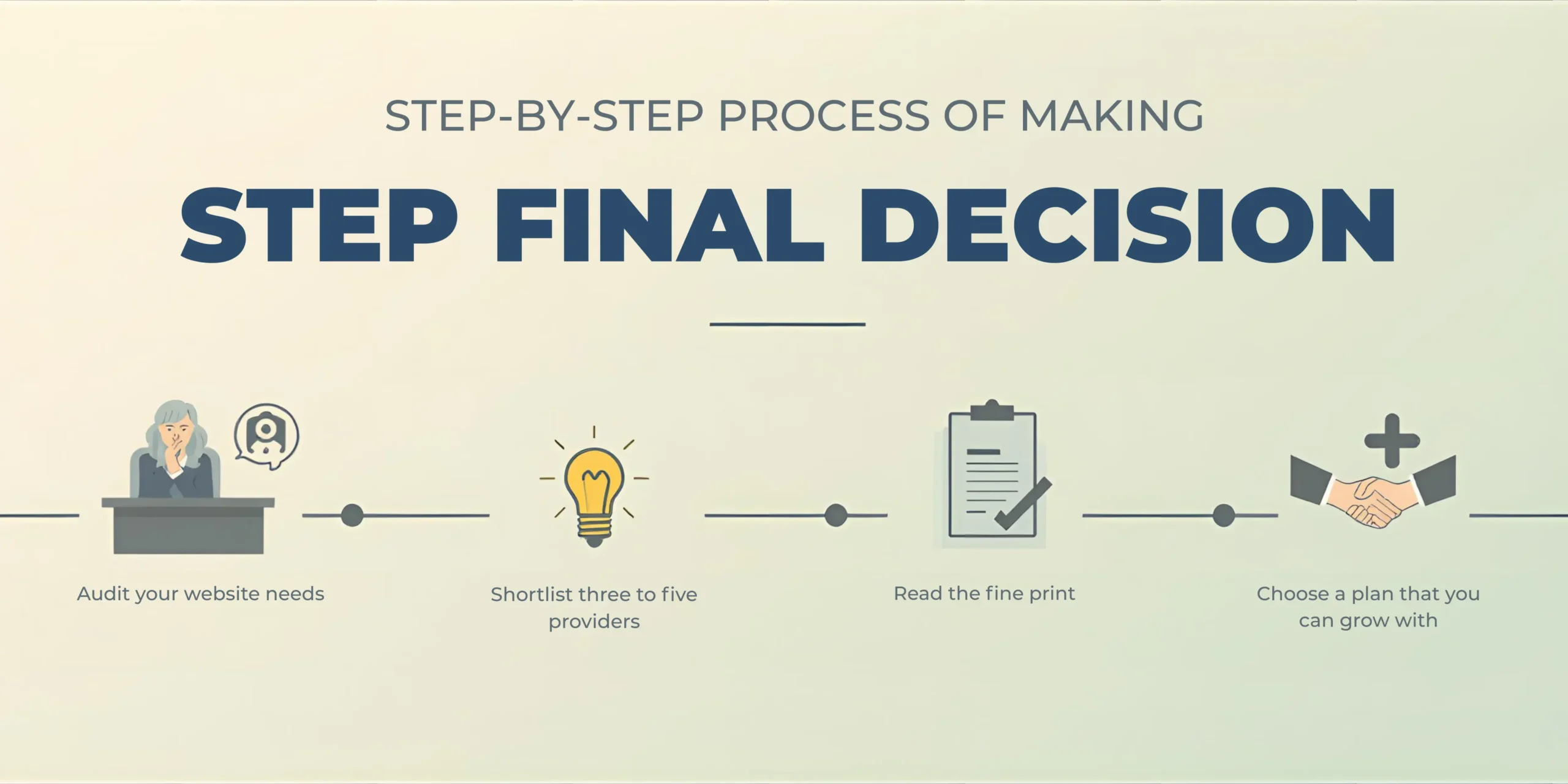
Step-by-step Process for Making Your Final Decision
Once you have a feel for the options, here is a practical sequence for narrowing things down and making a confident final call.
A) Audit your website needs
How big do you expect your website to be in the beginning? Write down the kind of site you want to run and how much traffic you expect to generate.
Note that if you have plans to handle payments or your business operates in a sector that requires compliance, you will need to look for a web hosting service that meets these requirements.
B) Set a realistic budget
After factoring in your website’s needs, set a realistic budget that includes renewal costs.
It’s cheaper in the long run to go with an annual plan than a monthly subscription to take full advantage of introductory pricing.
C) Shortlist three to five providers
Use your budget estimate to research and narrow down up to five hosting providers that fit your UAE-specific criteria.
You can easily eliminate providers that fail to answer questions about server location, security, and uptime SLA.
D) Test customer support
You can use the response time to answer any pre-sales questions you may have as a benchmark for how long they take to respond to support queries.
Note whether the response was helpful or too generic, and their attitude will be the clearest signal of what it will be like once you become a customer.
E) Read the fine print
Make sure that you can easily access and read the fine print on SLAs and cancellation terms.
A legitimate provider will share the required information without hesitation if you cannot find the documents on their website.
F) Choose a plan that you can grow with
Once you have settled on one hosting service provider, you should pick a subscription that meets your current needs.
The plan should include a clear, affordable upgrade path to avoid a disruptive migration when your business picks up pace.
Conclusion
Here is the thing about web hosting that most guides will not tell you upfront. t is not a technical decision. t is a business decision.
The server your website lives on determines how fast a customer in Sharjah loads your product page.
Whether you are legally compliant with the UAE’s Personal Data Protection Law, and whether your checkout survives the traffic surge when your Ramadan campaign hits.
Get it right, and it runs invisibly in the background. Get it wrong, and it becomes the most expensive cheap decision you ever made.
Are you ready to take your business to the next level with the best web hosting plan? Truehost is offering great web hosting plans perfect for your UAE business.
Frequently Asked Questions (FAQ)
For most UAE businesses, hosting on servers located in or near the UAE delivers faster load times for local visitors.
In addition to speed, certain business types are legally required to store specific categories of data within the country.
The hosting plan itself does not need to be different for a bilingual site. What matters more is that your content management system supports right-to-left text for Arabic.
A small business with a straightforward website and moderate traffic can expect to pay between AED 30 and AED 150 per month for a reliable setup with decent support.
Yes, switching providers is possible and reasonably common. Most established providers offer free migration services to help you migrate to their platform.
Not necessarily. The UAE PDPL focuses on how data is handled rather than mandating that all data must sit on UAE soil in every case. However, specific sectors, including healthcare and financial services, may have stricter requirements.