 Domain SearchSecure your perfect UAE domain in seconds.
 Domain TransferSeamless domain transfer. Zero downtime, complete control.
 All TLDsSecure your ideal domain. Explore local UAE and international extensions.
 WHOIS LOOKUPCheck domain ownership, expiry dates, and registrar details instantly.
 AE DomainRegister a .AE domain and build trust in the UAE.
 SSL CertificatesProtect your site with trusted SSL Certificates to secure data and build customer confidence.
 .com DomainGet the world’s most trusted domain and build credibility from day one.
 Web hostingFind budget-friendly hosting that doesn’t compromise on performance.
 Windows HostingHigh-performance hosting for Windows applications and websites.
 Affiliate ProgramBecome a partner and earn commission for every referral.
 WordPress HostingBlazing-Fast WordPress Hosting, Optimised for Performance.
 Email HostingSecure your communications with professional email hosting. Use your domain, stay in control.
 Reseller HostingLaunch your own hosting brand. We handle the tech, you grow your business.
 cPanel HostingHosting supported by cPanel (simple and user-friendly)
 VPS HostingVirtual servers that grow with you. Full root access. Blazing fast performance.
 Managed VPS HostingNot a tech expert? Let us handle everything with our fully managed VPS hosting.
 Dedicated ServersEnjoy full access and total control over your dedicated physical server.
 AI Website BuilderBuild beautiful websites instantly with AI.
 Online ShopCreate a professional online store. No coding needed.
 Web Design ServicesGet a custom website built for your brand and your goals.
 BlogDiscover resources on web hosting, e-commerce, digital marketing, and beyond.
 Contact UsWe are available 24/7 via chat or email
 SupportExplore guides and answers for all our services
Your website is finally gaining traction, and traffic is steadily rising. Then you start to notice the slow loading time, and the server errors during peak hours are becoming all too common.
After all, you picked shared hosting because it was cheap and got the job done. One traffic spike, one slow load time, one cryptic server error, and suddenly your shared hosting plan feels like a ticking time bomb.
You keep reading about something called a VPS. So what exactly is it, and do you actually need one?

What is a VPS?
A VPS, or Virtual Private Server, is essentially your own private section of a physical server that lives in a data center somewhere.
Here is the simplest way to picture it. One powerful physical server gets divided into multiple smaller virtual servers using software called a hypervisor.
Each of those virtual servers runs completely independently, with its own operating system, its own dedicated RAM, CPU, and storage, and its own set of rules. That is your VPS.
You also get root access, which means you can install software, configure your server environment, and manage everything the way you want.
9 Projects you Can Start With VPS Hosting
The combination of affordability and control makes VPS hosting attractive to a wide range of users. These include:

1) Hosting Websites and Web Applications
One of the most common reasons people move to VPS hosting is to improve their website’s performance and reliability.
Shared hosting works fine for very small sites, but once traffic grows, the limitations become obvious pretty fast.
Pages slow down, especially during traffic spikes, and you have no way to allocate more resources on demand.
E-commerce stores are a perfect example of websites that need more than shared hosting can offer.
A single checkout failure caused by server overload can cost real money. With a VPS, your store gets consistent resources regardless of what other users on the same physical machine are doing.
Web applications with custom backend logic, databases, or API integrations also perform much better on a VPS, since shared hosting environments often restrict what software you can run.
2) Running a Game Server
Hosting your own game server is one of the more popular reasons gamers and gaming communities choose VPS. Games like Minecraft, Rust, and Counter-Strike 2 require low-latency connections and reliable uptime.
Running a game server on a home PC ties up your internet connection and risks going offline whenever you restart your computer. A VPS keeps the server running around the clock without interruption.
Beyond availability, VPS hosting gives server admins full control. You can install custom mods, configure rules, and manage player permissions.
You can also adjust server settings without any restrictions imposed by third-party game server hosting companies.
3) Developing and Testing Software
Developers use VPS hosting regularly to create isolated environments for testing and staging.
Before pushing an update to a live website or application, it makes sense to test it in an environment that mirrors the production environment as closely as possible. A VPS lets you do exactly that without affecting real users.
It also plays a big role in DevOps workflows. Continuous integration and continuous deployment (CI/CD) pipelines often run on VPS instances, automating code testing and deployment steps.
Teams that work across different time zones or on distributed projects tend to rely heavily on VPS-hosted environments for consistency and collaboration.

4) Hosting Your Own Email Server
Running a private email server gives businesses a level of control that third-party providers cannot match.
With tools like Postfix and Dovecot installed on a VPS, you can manage your own spam filters, set storage limits, and keep sensitive communications off platforms like Google or Microsoft.
For companies in regulated industries, keeping email data on their own infrastructure can be a compliance requirement.
Even for smaller businesses, the ability to manage your own email setup without paying per-seat fees to an external provider adds up to meaningful savings over time.
5) Setting Up a Private VPN
Privacy-conscious users often use VPS hosting to run their own Virtual Private Network (VPN).
Rather than trusting a commercial VPN provider with their traffic, they set up their own server using tools like WireGuard or OpenVPN. The connection is encrypted, the server belongs to them, and there are no third-party logs to worry about.
Businesses use the same approach to create secure tunnels for remote employees. Instead of routing sensitive company data over a public internet connection, employees connect via a company-owned VPS that serves as a secure gateway.
It is a cost-effective way to handle remote access without the expense of enterprise-grade hardware.
6) Data Backup and Storage
A VPS makes a solid off-site backup destination for individuals and businesses that want more control over where their data lives.
Automated scripts can push backups of files, databases, and system configurations to a VPS on a set schedule. Unlike cloud storage services, you control access, pricing, and data retention policies.
This is especially useful for web developers managing multiple client sites. Having all client backups stored on a VPS they control means they are not dependent on a third-party service. These could change pricing, shut down, or experience an outage at the worst possible time.
7) Forex and Crypto Trading Bots
Automated trading has become a common use case for VPS hosting, particularly among forex and cryptocurrency traders.
Trading bots need to run 24 hours a day, 7 days a week, with a fast and stable internet connection. Running one on a home computer means dealing with internet outages, power cuts, and the need to leave a machine on constantly.
A VPS eliminates those problems. The bot runs on a remote server that stays online regardless of what is happening at home.
Proximity to exchange servers also reduces latency, which means trade orders are filled faster, and strategy performance improves.
8) Hosting VOIP Systems
Businesses that want to manage their own phone systems use VPS hosting to run VoIP software like FreePBX or Asterisk.
Rather than paying for traditional phone lines or expensive hosted PBX services, they configure their own system on a VPS and route calls over the internet.
The cost savings compared to traditional telephony can be significant, especially for businesses with multiple locations or large call volumes.
Having full control over the system also means you can add extensions, set up call routing rules, and integrate with CRM tools without waiting on a vendor to make changes for you.

9) Reseller Hosting
Web developers and reseller hosting agencies often use VPS hosting to manage client websites under one roof.
Instead of pointing each client to their own shared hosting plan, they host multiple sites on a single VPS and manage them from a single place. That setup makes updates, security patches, and backups much easier to handle at scale.
Some people take this a step further by selling hosting plans directly to clients.
By purchasing a VPS with enough resources, they can divide that capacity across multiple customers and generate recurring revenue from a setup they already have full control over.
Advantages of VPS Hosting Across All Use Cases
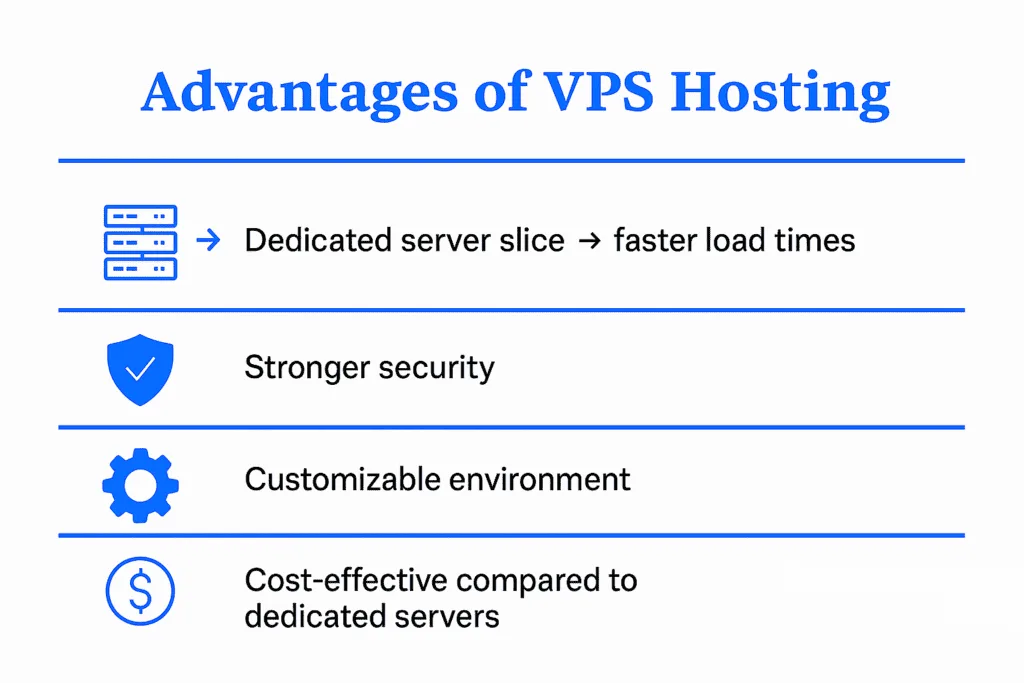
A) Dedicated Resources
Your RAM, CPU, and storage are yours alone. Unlike shared hosting, no other user on the same physical machine can dip into your resources.
So even if the site next door gets a sudden flood of traffic, your site keeps running smoothly.
B) Full Root Access
You have complete control over your server environment. That means you can install any software and configure security settings.
You can also set up custom server rules and tweak performance settings exactly as you need.
C) Better Performance and Reliability
Pages load faster, the server handles traffic spikes more gracefully, and downtime becomes far less common.
For e-commerce stores, high-traffic blogs, or any site where speed directly affects revenue, this reliability makes a real difference.
D) Improved Security
Your environment is fully isolated from other users on the same machine. One compromised account elsewhere on the server cannot touch yours.
You also get to configure your own firewall, set up your own security protocols, and control who has access to what.
E) Flexibility to Scale
Most VPS providers make it straightforward to upgrade your plan as your needs grow.
You can start small and add more RAM, storage, or CPU power when the time comes, without migrating to a completely different hosting setup.
F) Cost Efficiency
You get near-dedicated performance at a fraction of the cost of a full dedicated server. For small businesses, developers, and growing websites, that middle ground between price and performance is hard to beat.
G) Custom Software Environment
You can run whatever operating system, server stack, or application your project needs.
Whether that is a specific version of PHP, a Node.js app, a game server, or a trading bot. A VPS does not limit what you can install the way shared hosting does.
H) A Dedicated IP Address
A VPS gives you your own IP address, which matters for email deliverability and SSL certificate management.
Having a dedicated IP address avoids the reputation issues that can come from sharing an IP with hundreds of other websites on a shared hosting plan.
Things to Consider Before Choosing a VPS
1) Managed vs. Unmanaged
This is the first decision you need to make. An unmanaged VPS gives you full control but expects you to handle everything yourself, including server setup, software updates, security patches, and troubleshooting.
A managed VPS means the hosting provider handles the technical side for you. If you are not comfortable working in a Linux terminal, managed is the safer choice, even if it costs a bit more.
2) How Much Resource Do You Actually Need?
Buying more than you need wastes money. Buying too little means you will hit a performance ceiling faster than expected.
Think about your current traffic, the software you plan to run, and how much growth you expect in the next 12 months.
A basic website might run fine on 2GB RAM and 2 CPU cores, while a busy store or trading bot could need considerably more.
3) Storage Type and Speed
Always choose SSD storage over traditional HDDs. SSDs are significantly faster, which directly affects how quickly your server reads and writes data.
Some providers offer NVMe SSDs, which are even faster than standard SATA SSDs and are worth considering if performance is a priority.
4) Bandwidth and Data Transfer Limits
Some VPS plans cap how much data you can transfer each month.
If your site handles a lot of media, video, or high traffic volumes, hitting that cap can result in extra charges or throttled speeds.
Always check what the plan includes and what happens when you go over.
5) Operating System Options
Most VPS providers let you choose between Linux distributions like Ubuntu, CentOS, or Debian, and Windows Server.
Linux is free and more commonly used for web hosting. Windows Server licensing adds to the cost but may be necessary depending on the software you need to run.
Conclusion
VPS hosting sits in a unique position in the hosting market. It gives individuals and businesses a level of control and performance that shared hosting cannot match, without the full cost of a dedicated server.
If you have been running into limitations with your current setup, or if you have a specific project that needs more flexibility than shared hosting allows, VPS hosting is worth a serious look.
The right plan depends on your workload, your technical comfort level, and how much you expect your needs to grow.
Truehost offers unparalleled VPS hosting packages, managed and unmanaged, customizable to fit your business’s needs.