 Domain SearchSecure your perfect UAE domain in seconds.
 Domain TransferSeamless domain transfer. Zero downtime, complete control.
 All TLDsSecure your ideal domain. Explore local UAE and international extensions.
 WHOIS LOOKUPCheck domain ownership, expiry dates, and registrar details instantly.
 AE DomainRegister a .AE domain and build trust in the UAE.
 SSL CertificatesProtect your site with trusted SSL Certificates to secure data and build customer confidence.
 .com DomainGet the world’s most trusted domain and build credibility from day one.
 Web hostingFind budget-friendly hosting that doesn’t compromise on performance.
 Windows HostingHigh-performance hosting for Windows applications and websites.
 Affiliate ProgramBecome a partner and earn commission for every referral.
 WordPress HostingBlazing-Fast WordPress Hosting, Optimised for Performance.
 Email HostingSecure your communications with professional email hosting. Use your domain, stay in control.
 Reseller HostingLaunch your own hosting brand. We handle the tech, you grow your business.
 cPanel HostingHosting supported by cPanel (simple and user-friendly)
 VPS HostingVirtual servers that grow with you. Full root access. Blazing fast performance.
 Managed VPS HostingNot a tech expert? Let us handle everything with our fully managed VPS hosting.
 Dedicated ServersEnjoy full access and total control over your dedicated physical server.
 AI Website BuilderBuild beautiful websites instantly with AI.
 Online ShopCreate a professional online store. No coding needed.
 Web Design ServicesGet a custom website built for your brand and your goals.
 BlogDiscover resources on web hosting, e-commerce, digital marketing, and beyond.
 Contact UsWe are available 24/7 via chat or email
 SupportExplore guides and answers for all our services
Few buyers ever stop scrolling through the web hosting fine print and question what is 99.9% uptime and whether it actually matters.
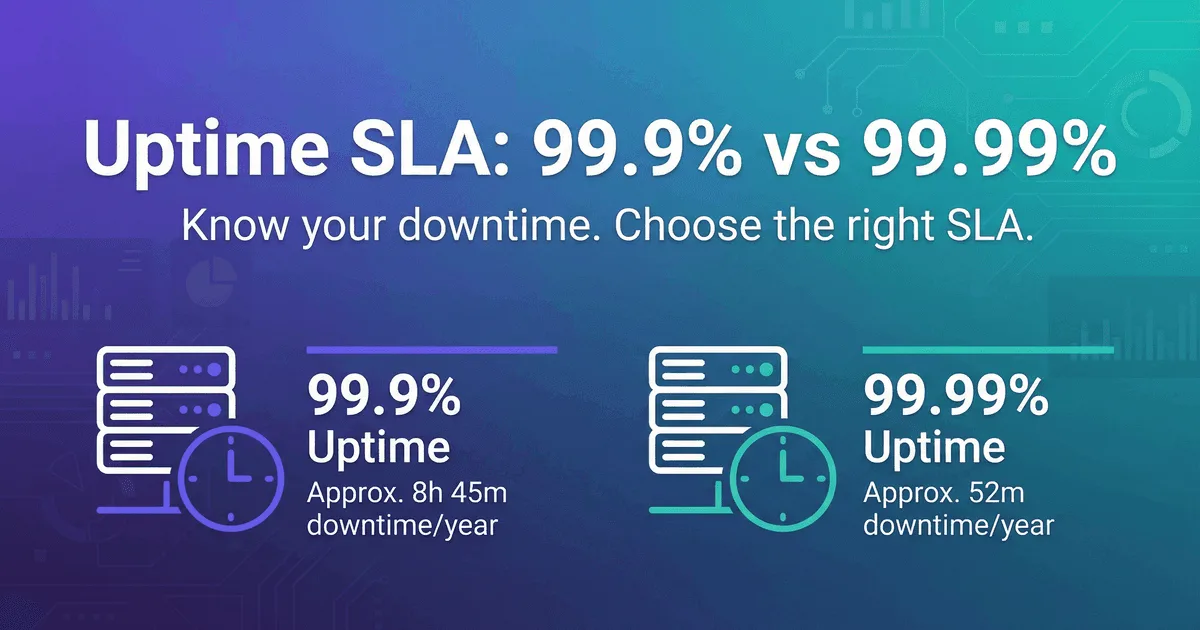
99.9% sounds impressive, and it’s not a loophole. That is the deal you agreed to until you realize it allows up to 8 hours and 45 minutes of downtime each year.
Whether those hours land at 3 AM or during your biggest sale of the year is a different question entirely, and one your SLA does not answer.
Let’s take a detailed look at what the uptime guarantee is, why it matters, and how it relates to SLAs.
Why Uptime Matters for Your Business
Before you look at percentages and SLA tables, there is a more basic question worth answering. Why does uptime actually matter?
The short answer: your website is often the first point of contact between your business and a customer. When it goes down, that contact disappears entirely.
1) Lost Revenue
The most direct consequence of downtime is lost sales. Every minute your site is unreachable, transactions cannot be completed.
For e-commerce businesses, that means abandoned carts and lost orders. For SaaS companies, it can mean failed renewals or users switching mid-trial.
Research puts the average cost of downtime at AED 500 to AED 2500 per minute for medium businesses. At the higher end, that is over AED 90,000 per hour.
2) Damaged Search Rankings
Search engines crawl your site regularly. When Google’s bots reach your pages and find them down, they register the failure.
A single short outage rarely causes lasting damage. But repeated outages, or those lasting several hours to days, create indexing gaps.
Pages that cannot be crawled may lose ranking positions. Recovery from those gaps can take days or even weeks of consistent availability.
3) Customer Trust and Churn
Trust is harder to measure than revenue, but the business impact is just as real. When a customer visits during an outage, they do not wait around.
Studies show that over 80% of users who hit a downed site will not return on the same day. A large portion will not return at all.
For subscription businesses, a payment or login page going down at the wrong moment can trigger cancellations that compound over months.
4) Brand and Reputational Damage
Word travels fast when a site goes down at a bad moment. Social media posts and review sites can turn a short outage into a lasting perception problem.
For newer or smaller businesses, a public outage during a product launch can undercut months of marketing work in a single hour.
5) Conversion Rate Erosion
Even partial downtime, where pages load slowly or intermittently, erodes conversion rates. A one-second delay in page load time reduces conversions by roughly 7%.
Full outages are obviously worse. But intermittent availability, sitting just inside an SLA threshold, can quietly cost you more than a single clean outage.
The Number Behind the Percentage
Most hosting providers display 99.9% uptime like a badge of honor. Let’s run the actual math so the number stops being abstract.
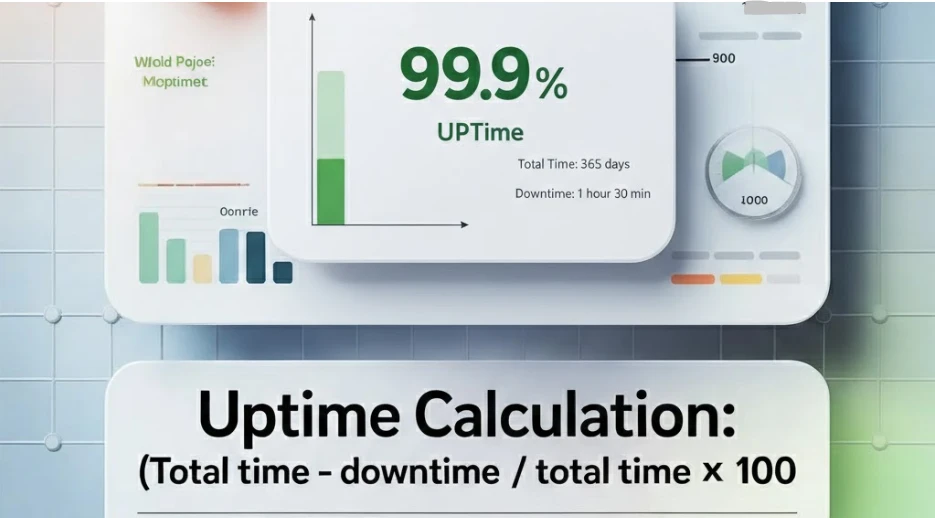
99.9% uptime means 0.1% downtime. Per year, that translates to 8 hours and 45 minutes. In a month, you are looking at roughly 43 minutes and 50 seconds. Per day, that is about 1 minute and 26 seconds of allowable outage.
Those figures do not sound alarming in isolation. Then you factor in timing, and the picture changes. An outage during your busiest hour hits very differently from one at 3 AM on a Sunday.
The industry uses shorthand called ‘nines.’ You count the nines after the decimal point. So 99% is ‘two nines,’ 99.9% is ‘three nines,’ and 99.99% is ‘four nines.’ Five nines (99.999%) allows less than 6 minutes of downtime per year.
The Nines Ladder: A Full Comparison
Here is every uptime tier side-by-side. The jump between each level is not linear. It gets exponentially harder and more expensive to climb higher.
| Uptime % | Name | Downtime/Year | Downtime/Month | Typical Use Case |
|---|---|---|---|---|
| 99% | Two Nines | 87.6 hours | 7.3 hours | Personal blogs, static sites |
| 99.9% | Three Nines | 8.76 hours | 43.8 minutes | SMB websites, small e-commerce |
| 99.99% | Four Nines | 52.6 minutes | 4.38 minutes | SaaS, mid-market e-commerce |
| 99.999% | Five Nines | 5.26 minutes | 26.3 seconds | Fintech, healthcare, enterprise |
Going from three nines to four nines cuts your allowed downtime by roughly 10 times.
Going from four nines to five nines cuts it by 10 times again. Each additional nine requires exponentially more engineering effort to maintain.
When 99.9% Uptime Is Perfectly Fine
Not every website needs four or five nines. For many businesses, three nines is a completely reasonable target.
A personal portfolio, a local restaurant page, or an informational blog rarely faces serious consequences from a 40-minute monthly outage. If your traffic is small and evenly spread throughout the day, a short outage is an inconvenience, not a crisis.
Three nines is achievable with solid VPS hosting, basic redundancy, and simple monitoring tools. You do not need a dedicated site reliability team to hit that target.
The cost-to-benefit math matters here. Achieving 99.999% requires multiple data centers, global failover infrastructure, and dedicated on-call engineering teams.
That level of investment makes sense for a payment processor. It does not make sense for a local bakery website.
When 99.9% Uptime Is Not Enough
There is a category of businesses where 99.9% uptime creates real, measurable financial risk. E-commerce is the most obvious example.
For SaaS products, payment infrastructure, and healthcare platforms, the stakes go further. Downtime in those spaces damages user trust and triggers breach-of-service agreements. In healthcare settings, it can affect patient safety.
The SLA and Uptime
An SLA (Service Level Agreement) is a formal contract between a service provider and a customer that defines the expected service level.
In the context of web hosting and uptime, the SLA typically spells out three things:
What the provider promises: the uptime percentage they guarantee (like 99.9%), how performance is measured, and what counts as a failure.
What happens when they fall short: usually, a credit or partial refund of your monthly fee if they breach the agreed threshold.
The exclusions: planned maintenance windows, third-party failures, or events outside the provider’s control. This is the fine print section that most people skip and later regret.
What the SLA Credit Is Actually Worth
Here is a real-world example. Say your hosting plan costs AED 50 per month. Your site generates AED 200 per hour. You experience an 8-hour outage. Your actual revenue loss is AED 1,600.
However, your SLA credit is calculated at 10% of the hosting cost, which equates to just AED 5 in SLA credits.
That gap is not an accident. SLA credit structures protect the provider from liability. They are not designed to make you whole.
This does not mean SLAs are worthless. They create a contractual floor for service quality. But treat an SLA credit as a formality, not a financial safety net. Plan your infrastructure as if the credit did not exist.
How Providers Actually Calculate the Uptime Number (Read the Fine Print)
Here is where things get uncomfortable. Not every provider calculates uptime the same way. There are three common SLA loopholes to watch for.

1) Planned Maintenance Exclusions
Many providers subtract scheduled maintenance windows from their uptime calculation. So if your site is down for 2 hours due to a scheduled upgrade, those hours may not count against the SLA at all.
2) Measurement Period Manipulation
Some providers calculate uptime monthly, while others use annual averages. Those two methods can produce very different numbers from the same actual outage history.
3) Scope Gaps
This is the most common trap. Many hosting SLAs only cover ‘network uptime,’ meaning the provider’s physical connection is live.
If your application crashes, your database fails, or your storage layer goes down, that may not count as an SLA breach. Yet your users see a blank page. The provider’s dashboard shows green.
Some providers also recognize outages only from their internal monitoring tools. If your independent monitor catches a 45-minute outage that their tool missed, the provider may reject your credit claim outright.
Credit claims are rarely automatic. Most SLAs require you to open a support ticket within a specific window, document the outage yourself, and wait for the provider to verify their own logs.
How to Verify a Provider’s Uptime Claims Yourself
Do not take a provider’s word for it. Set up your own monitoring from day one.
There are three types of monitoring worth knowing about. Probe-based monitoring pings your site at regular intervals from a remote server. Synthetic monitoring runs automated scripts that simulate real user actions. Real user monitoring (RUM) tracks actual visitor experiences in real time.
For most small and mid-sized businesses, probe-based monitoring is the right starting point. Tools like UptimeRobot, BetterUptime, and Hyperping are affordable and simple to configure.
Why Independent Monitoring Matters
- In a credit dispute, your provider points to their own monitoring data
- Without your own records, you have no counter-evidence
- A third-party incident log gives you a documented, timestamped case
A monthly audit habit pays off over time. Track your cumulative downtime against your SLA allowance each month. If you are approaching the limit, escalate with your provider before a breach occurs.
Choosing the Right Uptime Target for Your Business
Here is a plain-language framework to match your business type to the right uptime tier.
| Business Type | Target | Why |
|---|---|---|
| Personal blog or portfolio | 99% | Downtime is rare and consequences are minimal. |
| SMB informational or service site | 99.9% | Most quality VPS hosting plans hit this range. |
| E-commerce or lead-generation | 99.99% | Push providers on this. Ask what the SLA excludes. |
| SaaS, fintech, or healthcare app | 99.99%+ | Multi-region deployment and incident response process required. |
Conclusion
99.9% uptime is a reasonable starting point, not a finish line. The number only tells part of the story.
The fine print, the timing of outages, the scope of coverage, and your dependency chain all change what 99.9% actually means for your business.
Truehost offers the best web hosting plans with 99.9% uptime guarantees and top-of-the-line performance.