 Domain SearchSecure your perfect UAE domain in seconds.
 Domain TransferSeamless domain transfer. Zero downtime, complete control.
 All TLDsSecure your ideal domain. Explore local UAE and international extensions.
 WHOIS LOOKUPCheck domain ownership, expiry dates, and registrar details instantly.
 AE DomainRegister a .AE domain and build trust in the UAE.
 SSL CertificatesProtect your site with trusted SSL Certificates to secure data and build customer confidence.
 .com DomainGet the world’s most trusted domain and build credibility from day one.
 Web hostingFind budget-friendly hosting that doesn’t compromise on performance.
 Windows HostingHigh-performance hosting for Windows applications and websites.
 Affiliate ProgramBecome a partner and earn commission for every referral.
 WordPress HostingBlazing-Fast WordPress Hosting, Optimised for Performance.
 Email HostingSecure your communications with professional email hosting. Use your domain, stay in control.
 Reseller HostingLaunch your own hosting brand. We handle the tech, you grow your business.
 cPanel HostingHosting supported by cPanel (simple and user-friendly)
 VPS HostingVirtual servers that grow with you. Full root access. Blazing fast performance.
 Managed VPS HostingNot a tech expert? Let us handle everything with our fully managed VPS hosting.
 Dedicated ServersEnjoy full access and total control over your dedicated physical server.
 AI Website BuilderBuild beautiful websites instantly with AI.
 Online ShopCreate a professional online store. No coding needed.
 Web Design ServicesGet a custom website built for your brand and your goals.
 BlogDiscover resources on web hosting, e-commerce, digital marketing, and beyond.
 Contact UsWe are available 24/7 via chat or email
 SupportExplore guides and answers for all our services
Choosing between Linux vs. Windows VPS shouldn’t feel like walking on a tightrope, but it often does.
You open a hosting comparison page, see a wall of specs and pricing tiers, and end up more confused.
For the majority of workloads, one of these operating systems is a noticeably better fit than the other.
The difference shows up in your monthly bill and your server’s idle RAM usage. It also affects how fast security patches land, and how much freedom you have to configure things your way.
This guide breaks down exactly what separates the two, which one makes sense for your setup, and the edge cases.
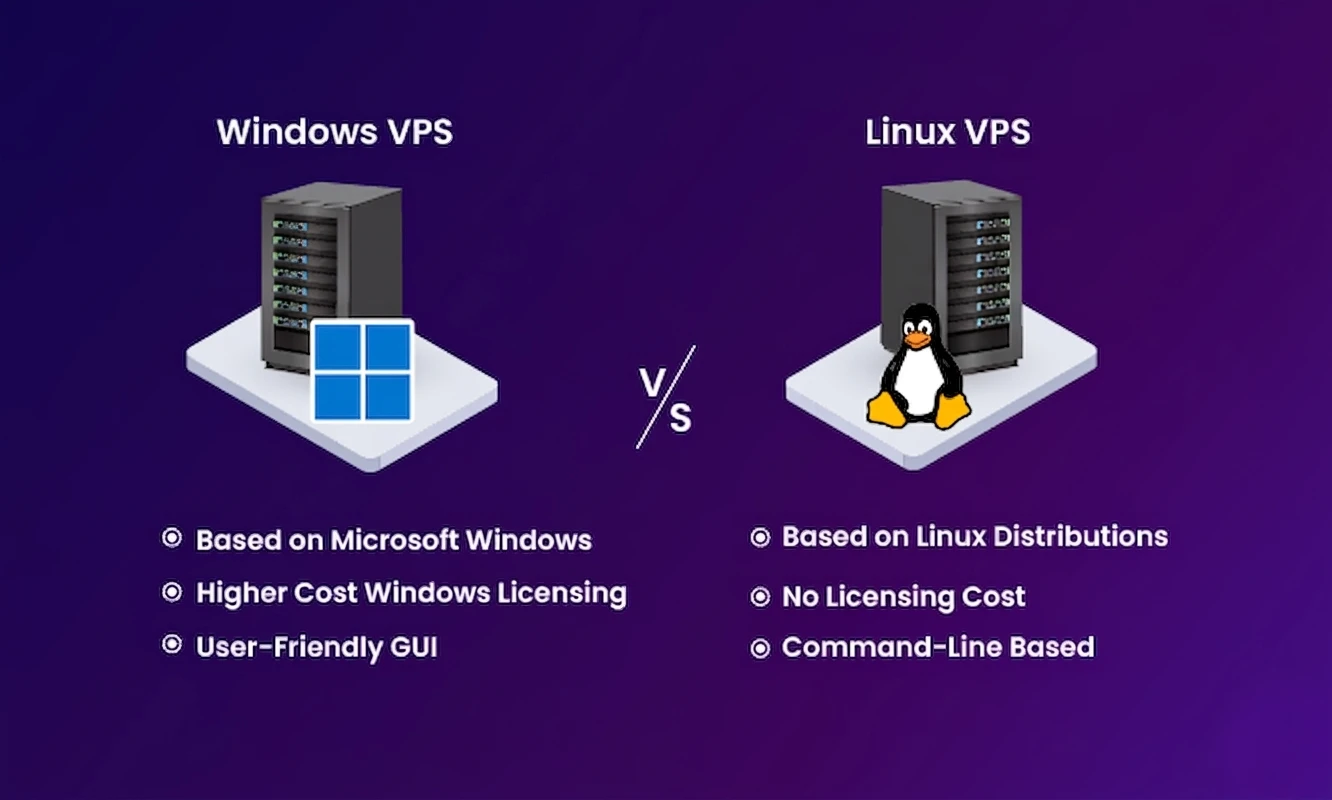
Linux VPS at a Glance
Linux is the operating system that runs the internet. That is not an exaggeration. Around 91% of all web servers worldwide run Linux.
Every single one of the world’s top 500 supercomputers runs Linux. Approximately 90% of virtual machines on AWS, Google Cloud, and Azure run Linux. The numbers are hard to argue with.
The reason Linux dominates is straightforward. The OS itself is free and open-source.
Linux VPS server consumes far fewer system resources than Windows Server, leaving more of your VPS hardware available for your actual applications.
Linux’s modular design was built for server environments. This architecture is efficient, stable, and well-suited for the kind of work web servers do.
Advantages of Linux VPS
1) Zero licensing costs for the OS itself.
Linux OS has no licensing fees, no Client Access Licenses, and no surprise charges at renewal.
2) Lightweight and efficient.
Linux frees up more RAM and CPU for your apps because it does not need to run a full graphical interface in the background.
3) A smaller attack surface for common malware.
Linux sees far fewer targeted attacks than Windows, partly by design and partly by volume.
4) Native support for the modern web stack.
PHP, Python, Node.js, MySQL, PostgreSQL, Docker, and Kubernetes all run natively on Linux.
5) Full root access.
With root access on Linux, you can run CI/CD pipelines, cron jobs, custom applications, and DevOps workflows without restrictions.
6) A wide range of distributions to choose from.
Linux distributions come in different flavors. Ubuntu, AlmaLinux, Rocky Linux, Debian, and CentOS each have strengths that suit different teams’ preferences.
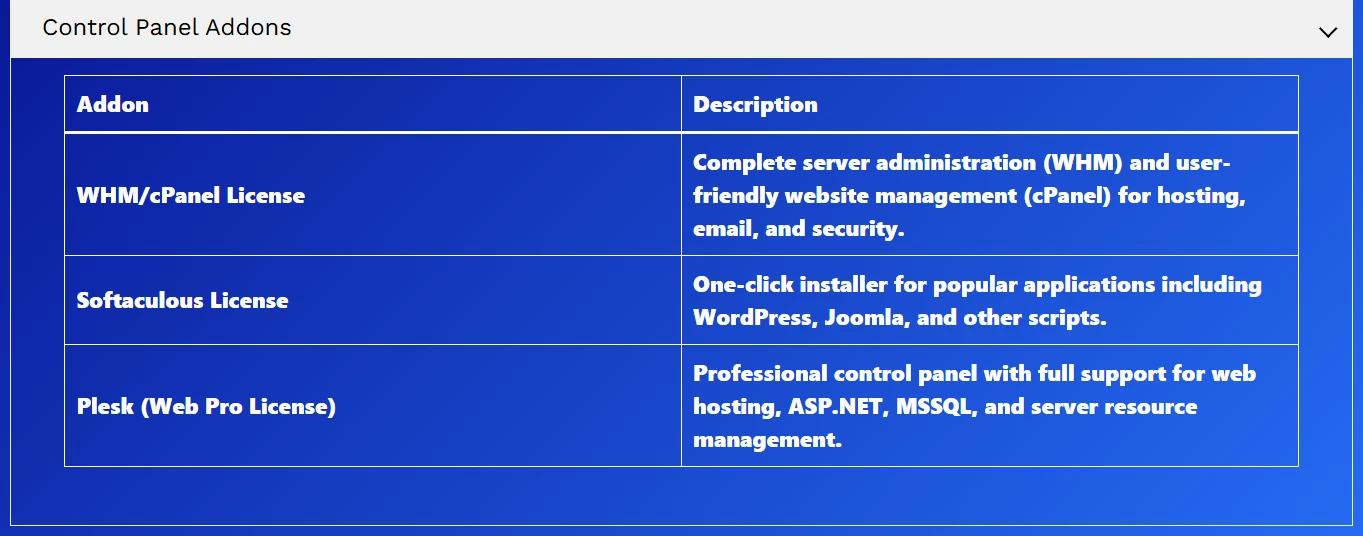
Control Panel Options on Linux VPS
If your team is not fluent in command-line operations, the right control panel removes much of the complexity from managing a Linux VPS. The most popular options in the UAE market are:
- cPanel: The most widely used control panel in the region, especially for web hosting and WordPress management. User-friendly and well-supported.
- Plesk: Works across both Linux and Windows, which is useful if you manage mixed environments.
- Webmin: Free and open-source. Good for technical teams that want control without the subscription cost.
Who Linux VPS Works Best For
- Web developers and digital agencies managing multiple client sites
- E-commerce stores built on WooCommerce, Magento, or PrestaShop
- Startups running containerized applications or microservices
- Businesses running WordPress at scale
- Development teams working with Python, Node.js, or Laravel backends

Windows VPS at a Glance
Windows VPS has a smaller market share in web hosting, but that does not mean it is the wrong choice. It means it serves a different set of needs.
If your business runs software built for the Windows ecosystem, Windows VPS is not a secondary option. It is often the only practical option.
Access to a Windows VPS typically occurs via the Remote Desktop Protocol (RDP). This is basically a window into a live Windows desktop that you can control remotely from anywhere.
For teams already familiar with Windows, the learning curve is close to zero.
Advantages of Windows VPS
1) Native support for the Microsoft stack.
ASP.NET, .NET Core, Microsoft SQL Server, and IIS all run at their best on Windows Server.
2) Active Directory integration.
For enterprises managing large numbers of users, permissions, and devices across departments, Active Directory on Windows is the standard approach.
3) A familiar interface.
Teams without deep Linux knowledge can set up, configure, and manage the server without needing SSH skills.
4) Multi-user RDP access.
Multiple team members can log into the same VPS remotely, which is particularly useful for shared workflow tools, accounting software, or legacy applications.
5) Enterprise software compatibility.
Many widely used tools in the UAE, including Microsoft Dynamics, Sage, Microsoft Office 365, Tally, and various ERP platforms, are built to run on Windows.
Licensing Reality
Here is where Windows VPS gets expensive. Windows Server uses a core-based licensing model. The Standard edition for a 16-core server costs approximately $1,176. The Datacenter edition runs around $6,771.
Beyond the server license, you also need to purchase Client Access Licenses (CALs) for every user or device that connects to the server.
These costs are built into the monthly price most VPS providers charge, but they are real costs that explain why Windows VPS plans are almost always more expensive than comparable Linux plans.
Who Windows VPS Works Best For
- Businesses running Microsoft Dynamics, SharePoint, or Exchange Server
- Companies with existing Windows-based internal tools or legacy applications
- Teams that need multi-user RDP access for shared remote desktop workflows
- Businesses deploying ASP.NET or .NET web applications
- Call centers and BPOs that rely on Windows-based dialers and CRM platforms
Linux Vs. Windows VPS for UAE Business
| Factor | Linux VPS | Windows VPS |
| OS Cost | Free (open-source) | $1,176 to $6,771+ per license |
| Web Server Market Share | ~96% of the top 1 million servers | ~2% of top 1 million servers |
| Management Interface | Command line (SSH) | GUI + Remote Desktop (RDP) |
| Best Tech Stack | LAMP, PHP, Python, Node.js, Docker | ASP.NET, MSSQL, Active Directory |
| Resource Usage | Lightweight | Higher requirements |
| Learning Curve | Steeper (CLI knowledge needed) | Easier (familiar Windows interface) |
| Security Profile | Smaller attack surface | Requires active patching |
| Support Type | Community + enterprise options | ~96% of the top 1 million servers |
1) Cost
Linux VPS is free at the OS level, which means your monthly hosting cost goes almost entirely toward the hardware resources you are renting.
Windows VPS passes along the licensing cost, which adds a consistent premium regardless of plan size.
For a small to mid-sized UAE business, that difference can add up to thousands of dirhams per year.
For startups watching their burn rate or SMEs managing lean budgets, this factor alone often settles the question.
Verdict: Linux wins on cost for most UAE businesses, particularly those not locked into the Microsoft ecosystem.
2) Performance
Because Linux runs without a mandatory graphical interface and carries a much smaller set of background processes, it leaves more CPU and RAM available for your applications.
On entry-level VPS plans, that efficiency gap is especially noticeable. Windows Server needs more resources just to run the OS itself, which means you often need a higher-tier plan to get equivalent application performance.
Verdict: Linux has the edge in raw resource efficiency. For resource-sensitive workloads, this matters.
3) Security
Linux has a smaller attack surface by default. Most common malware and ransomware targets Windows systems, so Linux environments face a lower baseline threat level.
That said, both operating systems can be hardened effectively. A well-managed Windows Server with proper patching and firewall configuration is perfectly secure.
An unmanaged Linux server with weak SSH passwords and no firewall rules is not. The real security variable is management quality, not the OS itself.
Verdict: Linux has a slight built-in edge, but active management matters more than either operating system’s defaults.
4) Ease of Use
This is where Windows has a genuine advantage. If your team is comfortable with Windows, setting up and managing a Windows VPS through RDP feels natural. There is no need to learn SSH, bash scripting, or file permission systems.
Linux, on the other hand, requires a meaningful level of comfort with the command line. For businesses without a technical co-founder or in-house developer, that can be a real barrier.
Managed Linux VPS hosting narrows this gap considerably by letting the provider handle OS-level configuration and patching.
Verdict: Windows is easier to manage for non-technical teams. Managed Linux hosting bridges the gap for everyone else.
5) UAE Compliance and Data Regulations
Both operating systems can be hosted within the UAE to meet data residency requirements. The compliance question, then, is less about which OS you choose and more about which provider you use and where their servers sit.
Verdict: Both are capable of meeting UAE compliance requirements. The choice often hinges on your existing tech ecosystem.
6) Scalability
Both Linux and Windows VPS plans let you upgrade RAM, CPU cores, storage, and bandwidth as your needs grow. The technical scalability is comparable. The cost scalability is not.
Since Linux has no per-core licensing fees, scaling up your server resources does not trigger additional OS costs. With Windows, larger servers mean more expensive licenses.
Verdict: Linux scales more cost-efficiently. Windows scales just as technically, but at a higher price per upgrade.
Linux vs. Windows VPS: The Verdict
| If You Are… | Choose… |
| A developer or digital agency | Linux VPS |
| Running Microsoft enterprise software | Windows VPS |
| A UAE startup with a modern app stack | Linux VPS |
| A non-technical team needing a remote desktop | Windows VPS |
| Budget-conscious (SME or solo founder) | Linux VPS |
| Running ASP.NET or .NET applications | Windows VPS |
| Hosting WordPress or WooCommerce | Linux VPS |
| Healthcare or government on Microsoft tools | Windows VPS |
| A call center or BPO needing shared RDP | Windows VPS |
| A SaaS startup with containerized apps | Linux VPS |
The honest bottom line is this: Linux VPS is the right starting point for most UAE businesses in 2025.
The cost savings are real, the performance advantage is measurable, and the web’s entire modern infrastructure runs on it.
For businesses that are not tied to a Windows-specific software stack, there is little reason to pay the premium.
Windows VPS earns its place, though, when your software ecosystem actually demands it.
If your team runs Microsoft Dynamics, deploys .NET applications, or needs multi-user RDP workflows, then Windows is not an inferior choice. It is the appropriate one.
The decision ultimately comes down to your software stack, your team capabilities, and your budget.
Conclusion
The best VPS operating system is the one that matches how your business actually operates. Before committing to a plan, audit the software your team relies on daily.
If it is web-based or modern-stack, Linux is likely the better fit. If it runs natively on Windows, especially legacy enterprise tools, then Windows VPS removes friction rather than creating it.
Truehost offers both managed and unmanaged VPS hosting options for Windows and Linux OS. Take your UAE business to the next level with our high-performance VPS packages today!