Logistics operations in 2025 are defined by volatility: fluctuating shipment volumes, unpredictable disruptions, cross-border constraints and increasingly demanding service-level agreements. In this environment, legacy on-premise or monolithic systems struggle to keep pace. Cloud-native infrastructure is no longer an optional deployment model; it has become a foundational requirement for serious logistics software, especially for depot, yard and terminal solutions.
This article explains why cloud-native principles matter so much in logistics, how containerization and Kubernetes change the operating model, and how topics such as SLAs, fault-tolerance, CDN usage, security and load resilience come together in production-grade SaaS for depots and terminals.
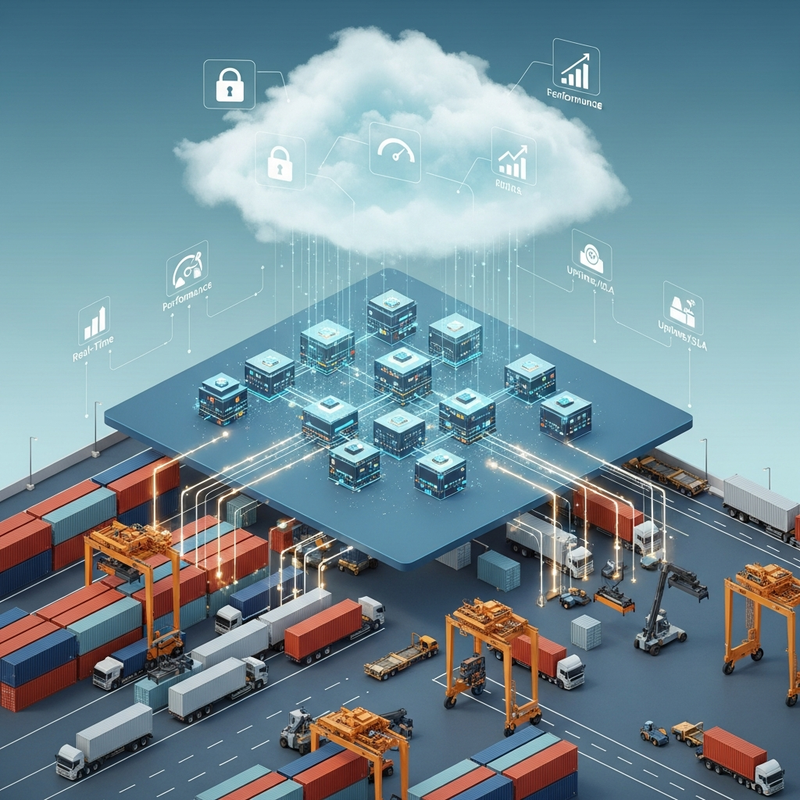
From Monoliths to Cloud-Native Architectures
Traditional logistics systems were often built as large monoliths, deployed on a few application servers in a local data center. Scaling meant “buying a bigger box”. Maintenance windows were long, upgrades were risky and multi-site deployments required significant custom work.
Cloud-native architecture shifts this paradigm. Applications are decomposed into services, packaged as containers, orchestrated on elastic infrastructure and accessed as SaaS. For logistics operators, the impact is straightforward: higher availability, faster feature delivery and the ability to cope with volume peaks without redesigning the entire system.
Containerization as the Operational Baseline
Docker and other container technologies have become the de facto standard for packaging modern logistics software. Instead of deploying directly on OS-level environments, each service runs inside its own container with a defined image, dependencies and configuration.
This brings several concrete benefits:
- Environment consistency: the same container image runs in development, staging and production, reducing “works on my machine” issues.
- Isolated dependencies: different services can use different runtimes, libraries or versions without conflicts.
- Faster rollouts and rollbacks: deploying a new version means swapping container images; if something fails, rolling back is just as fast.
For logistics software that must serve multiple depots, terminals or carriers, containerization also simplifies multi-tenant deployment: services can be replicated per tenant or shared with strong isolation, depending on design.
Kubernetes and Orchestration at Scale
Running a few containers on a single host is simple; running hundreds or thousands across regions, with proper scheduling, scaling and self-healing, is not. This is where Kubernetes (K8s) becomes central to cloud-native logistics platforms.
Kubernetes provides:
- Automated scheduling: pods (groups of containers) are placed on nodes based on resource requirements and constraints.
- Horizontal scaling: services scale out based on CPU, memory or custom metrics such as transaction volume or active yard sessions.
- Self-healing: failed containers are automatically restarted, and unhealthy instances are removed from service endpoints.
- Rolling updates: deployments can be updated gradually, without full downtime, and rolled back if necessary.
In logistics, this orchestration layer is particularly important during peak periods. For example, when gate transactions and API calls spike at the end of the month or around seasonal peaks, Kubernetes can automatically allocate additional capacity to the services handling check-ins, document processing or real-time tracking, rather than relying on static sizing.
SLAs, Fault-Tolerance and the Cost of Downtime
For operators of container depots, yards and terminals, downtime is more than an IT issue — it is a direct operational risk. If a yard system becomes unavailable during peak gate hours, trucks queue, equipment is underutilised and contractual SLAs with shipping lines or shippers may be breached.
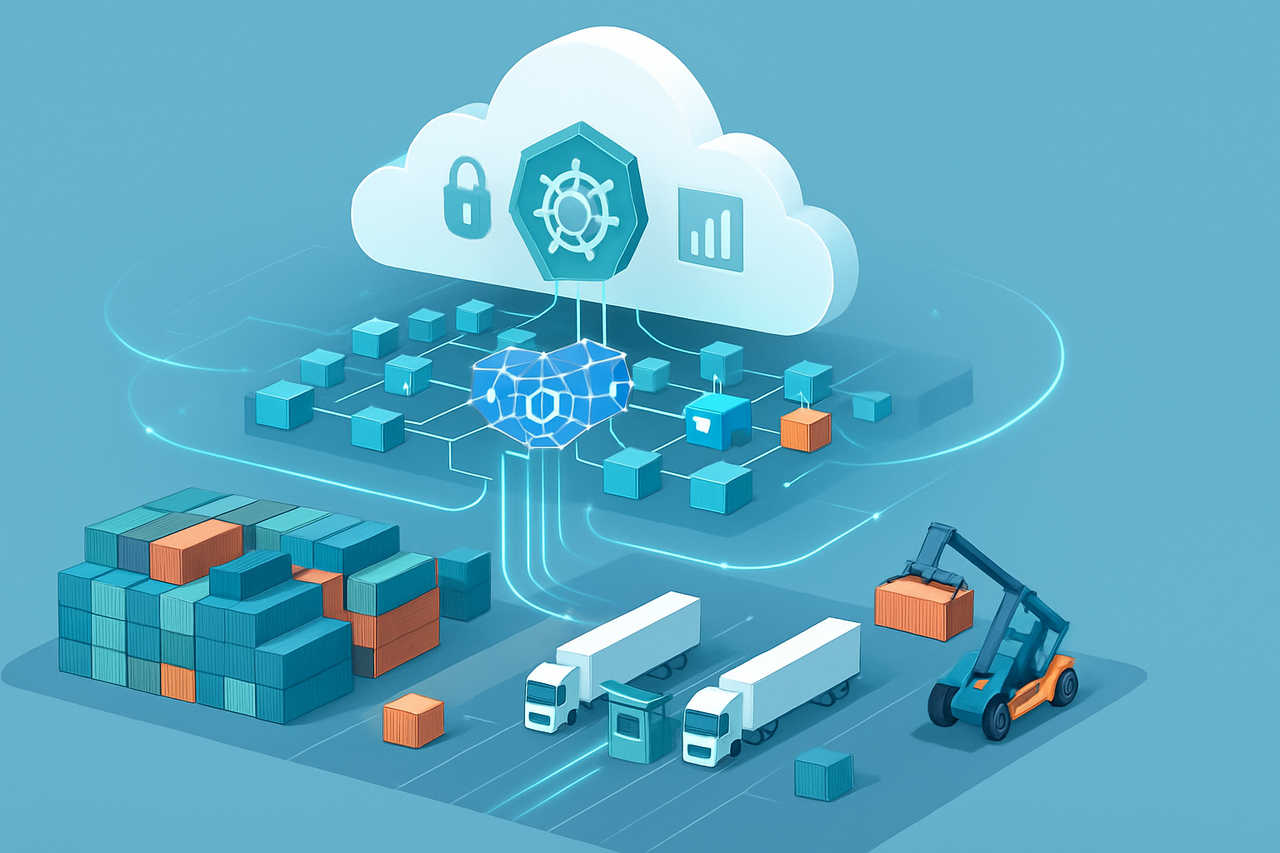
Cloud-native infrastructure contributes to SLA compliance and fault-tolerance in several ways:
- Multi-zone and multi-region deployments: critical services can run across multiple availability zones or regions, reducing the risk of a single data center failure.
- Redundant components: load balancers, message brokers and databases can be configured with replicas and failover mechanisms.
- Rolling maintenance: patches and updates are applied without taking the entire system offline, preserving uptime during planned work.
Modern SLAs for logistics SaaS systems often include uptime commitments of 99.9% or higher, plus response time targets for key operations. Achieving and monitoring those metrics is significantly easier when the platform is designed around cloud-native practices and supported by managed infrastructure.
Handling Load Peaks in Logistics Workloads
Logistics workloads are inherently uneven. A container yard might experience relatively quiet nights and weekends, but face intense bursts of activity when vessels arrive, trains are unloaded or promotional campaigns trigger a wave of e-commerce shipments.
Cloud-native platforms can absorb these peaks more gracefully:
- Autoscaling APIs and worker services based on queue length, message throughput or number of active sessions.
- Decoupling components with message queues so that downstream services can continue processing asynchronously even when requests spike.
- Using managed databases and caches that automatically scale capacity and IOPS rather than relying on fixed on-prem hardware.
From the user’s perspective, this means that gate transactions, yard views and planning screens remain responsive even during exceptional volume peaks. From an infrastructure standpoint, it means capacity can be bought and released on demand instead of overprovisioning permanently for worst-case scenarios.
CDN and Global Performance
Many logistics networks are geographically distributed: a depot system might be accessed from different countries, time zones and partner networks. Latency becomes a real consideration, especially for web-based interfaces, APIs and real-time map visualizations.
Content Delivery Networks (CDNs) help address this by caching static assets (JavaScript bundles, stylesheets, images) closer to end users and, in some cases, serving API traffic via edge endpoints. For global logistics platforms, CDN usage ensures that operators in distant regions can work with acceptable response times even if the core application is hosted in a central region.
In more advanced designs, edge computing patterns allow certain validation or routing decisions to be made at the edge, further improving responsiveness for distributed users and systems.
Data Security and Compliance in the Cloud
Logistics software handles sensitive information: shipment contents, trade documentation, pricing, customer identities and access credentials. Moving these workloads to the cloud increases both scrutiny and expectations around security and compliance.
Cloud-native infrastructure supports robust security postures through:
- Network segmentation and zero-trust principles: fine-grained access controls between services, environments and tenants.
- Encryption in transit and at rest: TLS for all external and internal traffic, plus encrypted storage for databases and object stores.
- Secret management: dedicated services for handling API keys, certificates and credentials rather than embedding them in configuration files.
- Audit logging and observability: detailed, immutable logs of access and configuration changes to support investigations and compliance audits.
Major cloud providers offer well-documented security and governance patterns; for example, technical best practices and reference architectures are regularly discussed in resources such as cloud provider engineering blogs. A well-designed logistics platform builds on these primitives while adding domain-specific controls, such as role-based access by depot, customer or region.
Cloud-Native SaaS for Depots and Terminals
For depots and terminals, the shift to cloud-native SaaS solutions is especially visible. Instead of procuring hardware, managing local installations and handling upgrades site by site, operators can subscribe to a centrally managed service that scales with their business.
Key characteristics of cloud-native SaaS for depots and terminals include:
- Multi-site support: multiple yards, depots or terminals operating on a single logical platform, with site-specific configuration and reporting.
- API-driven integrations: real-time connections with TMS, WMS, port community systems, carrier platforms and customs interfaces.
- Configurable workflows: ability to adapt gate processes, inspection steps and billing rules without custom code for each location.
- Centralised monitoring: one operational view of system health, performance and usage across all sites.
Solutions designed as cloud container yard software embody these principles: they are deployed in cloud environments, use container-based microservices, expose APIs and are maintained continuously by the vendor. For IT teams in logistics companies, this reduces the operational burden and allows them to focus on integration, process optimisation and data analytics rather than infrastructure maintenance.
Aligning Cloud-Native Design with Business Outcomes
Ultimately, cloud-native infrastructure is not an end in itself. It is a design choice that supports concrete business outcomes for logistics organisations:
- Higher reliability: fault-tolerant, redundant deployments support strict SLAs and reduce the risk of operational disruptions.
- Scalability: systems can grow with the network, supporting new depots, terminals and partners without major re-platforming.
- Faster innovation: container-based delivery pipelines and Kubernetes deployments allow frequent, low-risk updates with new features and improvements.
- Cost efficiency: pay-as-you-go infrastructure and elastic scaling reduce the need for static overprovisioning.
For modern logistics software — especially platforms that orchestrate depot, yard and terminal operations — these outcomes are critical. Customers expect real-time visibility, stable performance and rapid adaptation to new regulatory or commercial requirements. Cloud-native infrastructure provides the technical foundation to meet these expectations in a controlled, secure and scalable way.
Conclusion
As logistics continues to digitise, the infrastructure behind operational software becomes strategically important. Cloud-native principles — containerization, Kubernetes orchestration, robust SLAs, fault-tolerance, CDN-backed performance, strong security and resilient handling of load peaks — form the backbone of modern logistics platforms.
Organisations that invest in these architectures are better positioned to run reliable SaaS for depots and terminals, integrate with partners across the supply chain and adapt to the volatility that now defines global trade. Those that remain tied to static, non-elastic infrastructures will find it increasingly difficult to compete in an environment where uptime, responsiveness and data-driven decision-making are non-negotiable.